


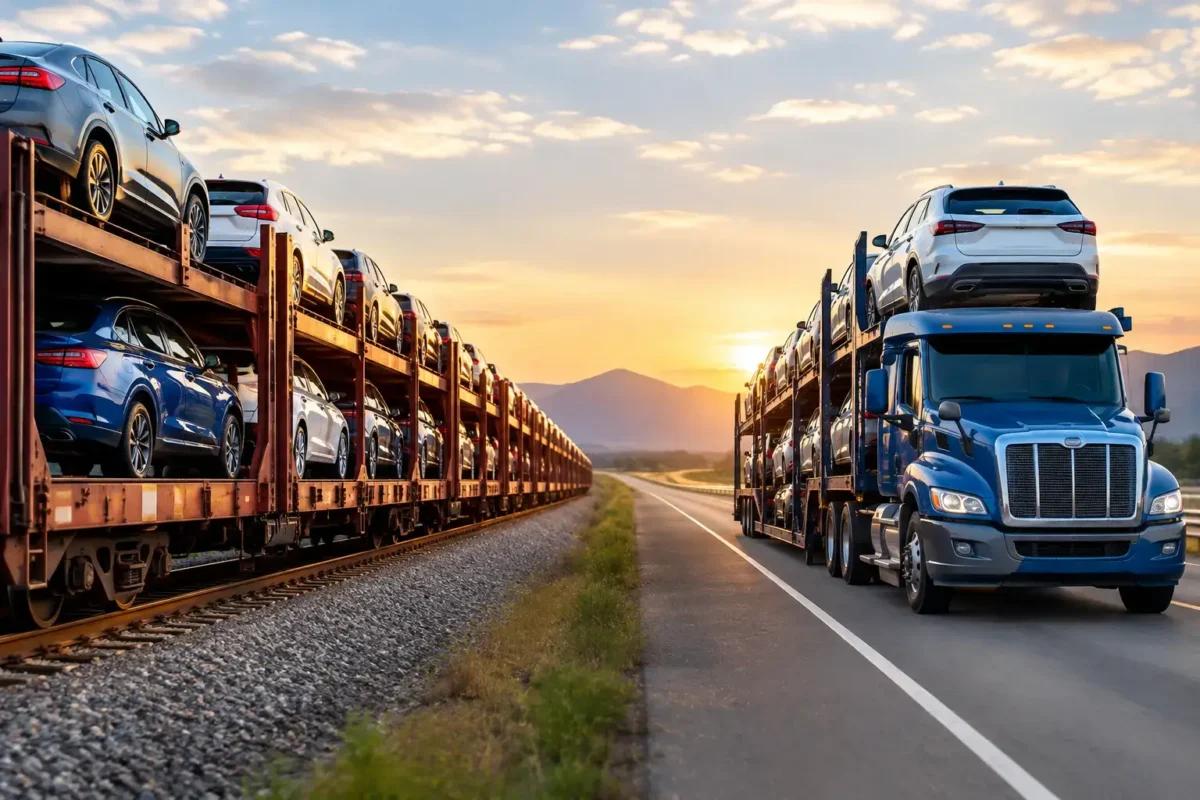
A cross-country move can make rail versus truck auto transport sound like a simple cost decision. In practice, the better choice depends on where the vehicle starts and ends, how quickly it needs to arrive, the level of protection it requires, and whether you can work around terminal schedules. For most individual vehicle owners, truck transport is the more accessible option because it can provide door-to-door service. Rail can make sense in certain high-volume corridors, but it comes with limits that are easy to overlook when comparing quotes.
How Rail Auto Transport Works
Rail transport moves vehicles on specialized railcars, usually along established freight corridors between major terminals. It is a familiar part of the automotive supply chain, especially for manufacturers and dealerships moving large volumes of new inventory. A railcar can carry many vehicles at once, which creates efficiency when the route and schedule line up.
For an individual customer, however, rail service is rarely as straightforward as loading a car near home and collecting it at the destination. The vehicle generally must be delivered to and picked up from rail terminals. Those terminals may be a significant distance from your origin or destination, and access can be limited based on the rail provider, route, and vehicle type.
Rail shipments also operate on freight schedules, not personal moving schedules. A car may wait for a railcar to fill, for a scheduled departure, or for unloading and transfer at the destination terminal. That does not make rail unreliable, but it does mean estimated timing can be less flexible than many customers expect.
Truck Auto Transport Offers More Route Flexibility
Truck auto transport uses carriers designed to move passenger vehicles, luxury vehicles, motorcycles, golf carts, and other equipment over the road. Open carriers are the standard option for most everyday vehicles. Enclosed carriers provide additional protection for high-value, classic, exotic, or low-clearance vehicles.
The biggest practical advantage is door-to-door coordination. The carrier can typically pick up and deliver as close to your requested address as local roads, parking restrictions, and truck access allow. If a residential street cannot accommodate a large carrier, the driver can often arrange a nearby meeting point such as a shopping center or wide parking lot.
This flexibility matters for families relocating, military members changing duty stations, online car buyers, and snowbirds who may not have time to travel to distant terminals. It also makes truck transport a stronger fit for routes that do not begin and end near major rail hubs.
Rail Versus Truck Auto Transport: Cost Factors
Rail is often assumed to be automatically cheaper. It can be cost-effective for high-volume shipments on a well-served route, particularly when a business is moving multiple vehicles between markets. For a single personal vehicle, the total expense may be closer than expected once terminal transportation, pickup arrangements, and timing requirements are considered.
Truck pricing depends on several operational details: total mileage, vehicle size and condition, route demand, fuel costs, season, carrier availability, and the type of trailer requested. A standard sedan on an active interstate route will generally have more carrier options than a non-running oversized SUV headed to a rural area.
The lowest quote is not always the lowest final cost. A very low estimate may leave out the practical challenges of a difficult pickup location, an urgent delivery request, or equipment needed for an inoperable vehicle. A clear transport quote should reflect the vehicle and route as accurately as possible, so there are fewer surprises when a carrier is assigned.
For customers comparing rail and truck, the useful question is not simply, “Which one costs less?” Ask what is included. Consider the distance to each terminal, the cost of your own travel, the potential need for local towing or a short-haul carrier, and the value of having your vehicle delivered near your destination.
Timing Is About Control, Not Just Speed
A truck may travel fewer miles per day than your own road trip would, because federal driving-hour rules and pickup and delivery stops affect the schedule. Still, over-the-road transport often gives customers more direct visibility into the process. The carrier is assigned to a defined route, and the driver can communicate when pickup and delivery windows become firm.
Rail can cover long distances efficiently, but total transit time includes more than train movement. Vehicles may spend time at origin terminals, destination terminals, or transfer points. If the rail leg requires truck delivery on either end, each handoff adds another scheduling step.
Neither method should be sold as a guaranteed exact-day service under every condition. Weather, traffic, mechanical issues, rail congestion, inspections, and route changes can all affect timing. The difference is that truck transport usually provides greater scheduling flexibility for individual shipments, especially when a customer needs pickup from a home, dealership, workplace, or storage facility.
Protection and Vehicle Condition
Rail vehicles are secured for transit, but they are commonly moved in multi-level railcars and may be exposed to normal transportation conditions. This can include dust, weather, rail debris, and handling during terminal operations. The exact protection level depends on the equipment and provider.
Open truck transport also exposes a vehicle to weather and road conditions, just as a vehicle would be exposed while being driven. It remains the practical, widely used choice for standard cars, trucks, and SUVs. Enclosed truck transport is the preferred option when protection is the priority, particularly for collector vehicles, luxury models, exotics, or vehicles with custom paint and low ground clearance.
Regardless of the method, inspection matters. Before pickup, document the vehicle’s condition with dated photos and note existing marks, chips, or mechanical concerns. Remove personal belongings unless the carrier has specifically approved limited items, secure or remove loose accessories, and keep the fuel level low enough for safe loading. At delivery, inspect the vehicle before signing the final condition report.
When Rail May Be the Better Fit
Rail can be worth considering when you are moving a large volume of vehicles, your origin and destination are close to accessible rail terminals, and your schedule has room for broader delivery windows. It may also suit fleet and dealership logistics where shipment efficiency matters more than residential convenience.
It is less likely to be the best fit for a single customer who needs a specific pickup date, lives far from a rail terminal, is relocating to a rural area, or wants additional protection for a specialty vehicle. Rail options can also be limited for modified, inoperable, oversized, or unusually valuable vehicles.
When Truck Transport Is Usually the Better Choice
Truck transport is generally the more practical option for personal vehicle shipping. It is especially useful when you want door-to-door service, need a carrier that can handle an inoperable vehicle, require enclosed transport, or are shipping to a location not served by a convenient rail terminal.
It is also the natural choice for customers sending vehicles to or from places where rail does not complete the journey, including Alaska, Hawaii, Puerto Rico, and other offshore destinations. Those shipments may involve port coordination and ocean transport, but a truck carrier is often needed for the inland pickup or final delivery portion.
Garcia’s Auto Transport and Logistics helps customers compare carrier options based on the actual route, vehicle, timing needs, and level of protection requested. The goal is not to force every shipment into one method. It is to coordinate a practical plan with clear expectations from booking through delivery.
Questions to Ask Before You Choose
Before selecting rail or truck transport, confirm whether the quote includes terminal handling, local delivery, insurance coverage, and any required vehicle preparation. Ask for a realistic pickup and delivery window rather than an overly precise promise that does not account for transportation conditions.
You should also tell the coordinator if the vehicle is modified, oversized, lowered, non-running, or carrying a roof rack, bike rack, or other accessory. These details affect the type of carrier that can safely transport it and help avoid delays on pickup day.
The right choice comes down to the service you actually need. If terminal-to-terminal shipping works with your location and schedule, rail may be worth exploring. If convenience, communication, flexible routing, or vehicle-specific handling matters more, truck transport is usually the clearer path. A detailed quote built around your real pickup and delivery needs will give you far more confidence than choosing based on price alone.
